

COP17 to the Convention on Biological Diversity (CBD)
Share:
Go to:
From 19-30 October, COP17 of the Convention on Biological Diversity takes place in Yerevan, Armenia. As the first Biodiversity COP to include a Global Review, the COP will focus on progress, monitoring and implementation. The Netherlands will host a Netherlands Pavilion, bringing together expertise and perspectives on biodiversity finance and the water–biodiversity–food nexus.
Meet us at the Netherlands Pavilion
The Netherlands Pavilion at COP17 will have over 60 inspiring presentations, offering participants a diverse array of insights and innovative solutions that span finance, biodiversity, water management, and sustainable development.
The Netherlands Pavilion focusses on the following themes.
- Water
- Finance and Private Sector engagement
- Mainstreaming
- DSI
- Social inclusivity
- Nexus
Which session belongs to the themes can be found in the programme. Each theme has a specific colour and matches a session.
Sessions at the Pavilion will not be recorded or livestreamed and there are no translation services available.
Programme Netherlands Pavilion
Please find the programme of the Netherlands Pavilion via the button below.
Programme booklet Netherlands PavilionResults of the official negotiations during COP 17 in Yerevan, Armenia
During the official negotiations at COP17 in Yerevan, Armenia, frequent reference was made to the ‘Big Four’: the four major political issues on which progress had to be made: the Global Review, Finance (resource mobilisation), DSI (digital sequence information) and ‘8J’ (Indigenous Peoples and local communities). COP17 ultimately delivered an outcome on all four.
Global Review
- The Global Review constitutes the first stocktake of the Global Biodiversity Framework. The message conveyed by the COP through the associated ‘Yerevan Pathway’ is clear: urgent action and accelerated implementation are needed.
- The text recognises the need for stronger action in areas including addressing the underlying drivers of biodiversity loss and reversing incentives that are harmful to biodiversity, a first! This call was heard loud and clear, including beyond the negotiations themselves.
- The Armenian Presidency initially aimed to conclude the Global Review during the high-level segment. However, Brazil blocked this, insisting that the decision on finance had to be finalised before it could agree to the Global Review (despite being content with the substance of the text itself). On the final day, Brazil adopted a more flexible position.
Resource Mobilisation
- Given the political dynamics (in particular, strong opposition from Saudi Arabia) and the fact that no textual negotiations on broadening the donor base took place throughout the COP, reaching an outcome on this issue at all is an achievement. Moreover, once the text was brought to plenary, it was adopted by consensus in a single sitting.
- The text acknowledges that a small group of countries currently provides contributions to developing countries, and that broadening this group could have a positive impact on mobilising biodiversity finance. This is a first and therefore a significant gain. COP18 will also review the list of donors, with further discussions on broadening the donor base to take place at that stage.
- Regarding the financial mechanism, seven additional criteria were agreed, which will need to be taken into account at COP18 when considering the definitive financial mechanism. Although the EU would have preferred not to include these criteria, the assessment is that the outcome is manageable and still provides a basis for advocating at COP18 for the retention of the GEF as the financial mechanism.
8J
- COP17 perhaps delivered its biggest surprise on 8J. For a long time, no agreement could be reached on the modus operandi of the permanent subsidiary body on Indigenous Peoples and local communities, established by decision of COP16. This was mainly due to opposition from Russia and Indonesia. Given the longstanding and considerable differences between positions on this issue, expectations were not particularly high.
- Nevertheless, agreement was finally reached at 8 am on Saturday 31 October, meaning that the subsidiary body can now become fully operational. The right to self-determination has largely been preserved. Where positions had been firmly entrenched on both sides, an interim solution was agreed.
DSI
- Meaningful progress was also achieved on DSI (digital sequence information) at the last minute, at 5.30 am on Saturday 31 October. This came as a considerable surprise, given the setbacks during the preparatory negotiations last summer, which meant that discussions were already starting at COP 17 at a disadvantage. The lack of willingness to make concessions, particularly on the part of the African Group, also played a role.
- When hopes had effectively been abandoned, one final attempt was made through a Presidency text on a ‘take it or leave it’ basis. The text was ultimately adopted at 5.30 am local time.
- The Presidency text provides a mandate for intersessional work in preparation for the planned review of the multilateral mechanism at COP18.
COP 18 on Biodiversity
Following a closely contested vote between Ecuador and Panama, Ecuador was elected as the host of COP18 by a margin of just two votes (55 to 53). Quito will therefore welcome the world in 2028. Ethiopia has already expressed its interest in hosting COP19.
In the coming period, the Ministry of Agriculture, Fisheries, Food Security and Nature will work on a letter to the Dutch Parliament providing a more detailed account of the outcomes. This will also cover the broader Dutch engagement beyond the negotiations, as well as the visit by the Minister for Agriculture, Fisheries, Food Security and Nature, Jaimi van Essen Wednesday 28 October.”


Why visit the Netherlands Pavilion?
The Netherlands Pavilion stands out as a knowledge-sharing platform where you can discover cutting-edge approaches to aligning financial flows with nature and advancing biodiversity goals. You will gain insights into actionable solutions that support both environmental and community resilience while networking with global leaders working toward the same goals.
The pavilion offers a space where you can:
- Engage with experts on topics such as biodiversity finance, sustainable food systems, and/or water stewardship.
- Connect with key stakeholders from government, business, academia, and civil society.
- Build partnerships and join a community of frontrunners driving global change.
By visiting the Pavilion, you will be at the forefront of transformative ideas that not only address the challenges of biodiversity and climate change but also explore practical steps to achieve lasting impact through finance, policy, and community-driven initiatives.
Important! If you are planning to visit the Netherlands Pavilion, please read this carefully.
You can only visit the Netherlands Pavilion if you are accredited and registered for the Blue Zone of the COP 17 Biodiversity, where the Netherlands Pavilion is located. For more information to access the Blue Zone, all necessary information can be found on this website. Please follow the instructions under the “Registration” tab. You can only get accreditation through a contracted party or organisation with observer status. Please note that the organisation of the Netherlands Pavilion is unable to assist with registration for COP 17 Biodiversity.
Organisation
The programming of the Netherlands pavilion is coordinated by Partners for Water, the Ministry of Agriculture, Nature and Food Quality, the Ministry of Infrastructure and Water Management and the Ministry of Foreign Affairs.
How to spot the Netherlands Pavilion?
See an impression on how the Netherlands Pavilion will look like. Look for our design in bright orange colours.
Floor plan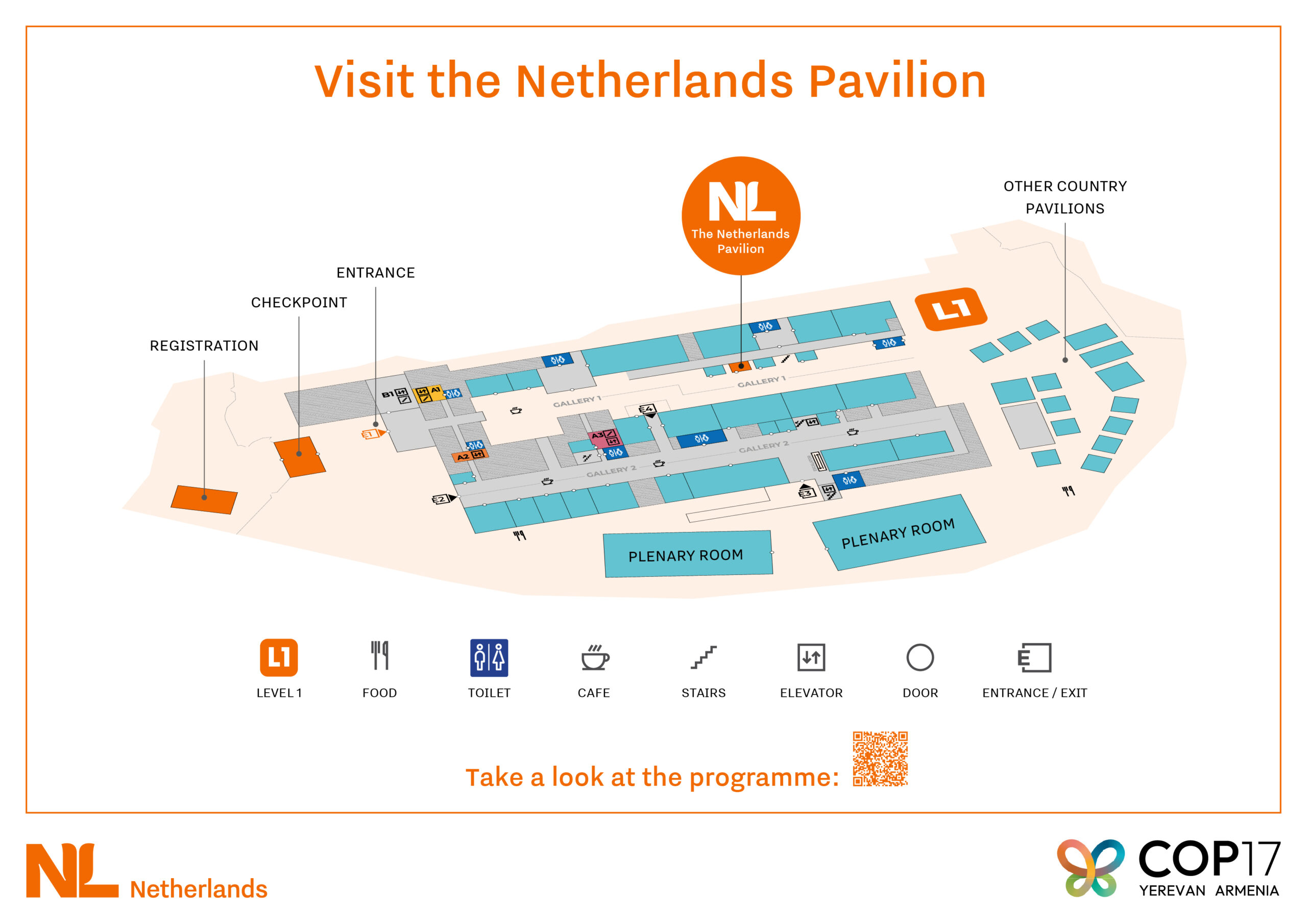


Presentations Monday 19 October
Total of presentations of Monday 19 October
Citizen Action Plan: Armenia in Action for the KMGBF
10:00-10:30Presentation Citizen Action Plan: Armenia in Action for the KMGBF
No Nature Protection Without Rights – Indigenous Leadership At The Center
14:15-15:15Dutch stakeholder perspectives on Access and Benefit-Sharing
15:30-16:30Presentation Dutch stakeholder perspectives on Access and Benefit-Sharing
Presentations Tuesday 20 October
Total of presentations of Tuesday 20 October
Area-based conservation futures: exploring the role of Indigenous and Traditional Territories in achieving the GBF
10:00-11:00Information flows to scale finance for biodiversity
11:15-12:15Presentation Information flows to scale finance for biodiversity
From principles to practice: scaling inclusive nature action through the Global Biodiversity Framework
13:00-14:00From fragmentation to action: Mobilising finance for locally-led conservation
14:15-15:15Presentation From fragmentation to action: Mobilising finance for locally-led conservation
How can we strengthen global scientific coordination to support implementation of the Kunming-Montreal Global Biodiversity Framework
15:30-16:30Sizing the Cali Fund: revenue potential and the case for corporate participation
16:45-17:45Presentation Sizing the Cali Fund: revenue potential and the case for corporate participation
Presentations Wednesday 21 October
Total of presentations of Wednesday 21 October
A process to accelerate the delivery of the 2030 forest goal
10:00-11:00Presentation A process to accelerate the delivery of the 2030 forest goal
From Fragmented Instruments to Connected Infrastructure: Building the EU’s Nature Finance and Governance Landscape
13:00-14:00Presentation 2: Nature Offsetting in Germany
Presentation 3: The Landbanking Group
Presentation 4: Water Resilience Lab
Presentation 5: Accelerating the transition towards a nature positive financial sector
From principles to practice: scaling inclusive nature action through the Global Biodiversity Framework
14:15-15:15Presentation Generating Impact: Scaling Dutch international partnerships for Nature-Based Solutions
Tracking Indicator D3 – How much does private finance contribute to biodiversity positive outcomes?
15:30-16:30Linking better biodiversity performance to economic feasibility: Measuring and Rewarding Biodiversity in Dairy
16:45-17:45Deepdive on State of Nature Data for Effective Decisionmaking
18:00-19:00Presentation Deepdive on State of Nature Data for Effective Decisionmaking
Presentations Thursday 22 October
Total of presentations of Thursday 22 October
From Nature-based Solutions to Investable Water Landscapes: Using Ecosystem Service Valuation to Build Better Business Cases, Public–Private Partnerships and Water Resilience
10:00-11:00From screening to financial risk assessments: science-based approaches for biodiversity physical risk assessment in the banking sector
11:15-12:15From Water Risk to Financial Resilience: Developing the Next Generation of Nature Stress Tests
13:00-14:00From Water Risk to Financial Resilience: Developing the Next Generation of Nature Stress Tests
From global ambition to national targets: learning from and responding to collective ambition under the GBF
14:15-15:15Unlocking Private Finance for Nature-based Solutions through the Value of Ecosystem Services
15:30-16:30From commitments to action: circular economy as a nature-positive finance opportunity
16:45-17:45From commitments to action: circular economy as a nature-positive finance opportunity
Launching Recommendations to Scaling Nature in Transition Planning
18:00-19:00Presentation Launching Recommendations to Scaling Nature in Transition Planning
Presentations Friday 23 October
Total of presentations of Friday 23 October
One Forest, Many Expectations: Connecting biodiversity frameworks through sustainable forest management
09:00-09:45Financing Urban Nature: New Tools for Cities
10:00-11:00Presentation Financing Urban Nature: New Tools for Cities
Mobilising Private Capital with Nature
11:15-12:15Presentation Mobilising Private Capital with Nature
Mainstreaming Biodiversity in Policy Practice
13:00-14:00Presentation Mainstreaming Biodiversity in Policy Practice
NBFPs in Practice: Early Lessons from NBFP Development
15:30-16:30Presentation NBFPs in Practice: Early Lessons from NBFP Development
Nature in Sovereign Debt – A collective intelligence workshop to define priorities in public-private dialogue
16:45-17:45
Are we on a credible pathway towards meeting the 2050 goals of the GBF? Towards just and effective implementation
18:00-19:00Presentations Monday 26 October
Total of presentations of Monday 26 October
Public Procurement as a Biodiversity Lever: True Cost Accounting and True Pricing in Food Systems
09:00-09:45Drenthe’s Natural Capital: From Value to Decisions
10:00-11:00Presentation Drenthe’s Natural Capital: From Value to Decisions
Aligning the Economy with GBF Targets: Nature-Positive Transition Pathways, Economic Planning, and Enabling Policies
13:00-14:00Setting the Table for Change How food systems partnerships can accelerate implementation of the Global Biodiversity Framework
14:15-15:15From Biodiversity Ambition to Investment Reality: Lessons from DFCD
16:45-17:45Presentation From Biodiversity Ambition to Investment Reality: Lessons from DFCD
Reconnect Borneo: Financing Nature at Scale – From ambition to implementation
18:00-19:00Presentation Reconnect Borneo: Financing Nature at Scale – From ambition to implementation
Presentations Tuesday 27 October
Total of presentations of Tuesday 27 October
Financing Nature Through Business Operations, Turning everyday corporate investment into biodiversity, water and community outcomes
09:00-09:45Insurers and the Global Biodiversity Framework: managing risk, unlocking finance, enabling the transition
10:00-11:00From Santa Marta to Yerevan: What countires can learn from emerging fossil fuel phase-out roadmaps for climate and nature
11:15-12:15Mainstraiming Biodiversity: How to achieve target 14?
13:00-14:00Presentation Mainstraiming Biodiversity: How to achieve target 14?
Fair & Equitable, but Effective? pragmatic approaches to access & benefit sharing
14:15-15:15Presentation Fair & Equitable, but Effective? pragmatic approaches to access & benefit sharing
The role of the finance sector in achieving the KMGBF goals and targets
15:30-16:30Presentation The role of the finance sector in achieving the KMGBF goals and targets
Financing the agricultural transition: overcoming barriers and unlocking solutions to achieve Target 10 of the Kumming-Montreal Global Biodiversity Framework
16:45-17:45Calling for the successful establishment of the Tropical Forest Forever Facility
18:00-19:00Presentation Calling for the successful establishment of the Tropical Forest Forever Facility
Presentations Wednesday 28 October
Total of presentations of Wednesday 28 October
Aligning Ambition on KMGBF Target 16: Building Coordinated National Policies and Footprint Indicators
09:00-09:45Understanding the user: matching biodiversity impact tools with private sector demands
10:00-11:00Presentation Understanding the user: matching biodiversity impact tools with private sector demands
Restoring land, redirecting finance: Re-aligning financial flows to deliver nature positive outcomes
14:15-15:15What if Biodiversity Became a Partner? Changing Mindsets and Consumption Patterns for Food systems transformation
15:30-16:30Presentations Thursday 29 October
From Biodiversity Data to Decision-Useful Nature Intelligence
10:00-11:00Presentation: From Biodiversity Data to Decision-Useful Nature Intelligence
IDFB – Nature Finance policy insights from COP17
11:15-12:15Presentation IDFB – Nature Finance policy insights from COP17
Banks as enablers/disablers for mainstreaming biodiversity
13:00-14:00Presentation Banks as enablers/disablers for mainstreaming biodiversity
Turning the Tide: An ecosystem services-based framework to estimate benefits and costs of riverine and offshore plastic cleanup interventions
14:15-15:15Harnessing the Nexus: Biodiversity and Restoration in Saline Landscapes
15:30-16:30Presentation Harnessing the Nexus: Biodiversity and Restoration in Saline Landscapes
From Commitment to Capital: Unlocking Investment for Nature-positive Delivery
16:45-17:45Presentation From Commitment to Capital: Unlocking Investment for Nature-positive Delivery
Financing Healthy Watersheds: Urban Nature-Based Solutions for Water, Biodiversity and Climate Resilience
18:00-19:00Presentations Friday 30 October
Bridging global ambitions and local action through place-based financing mechanism
11:15-12:15Presentation Bridging global ambitions and local action through place-based financing mechanism
Biodiversity Monitoring System: Ghana’s Experience
13:00-14:00Media coverage
See how the event has been featured in the media and explore the stories and articles highlighting the event.
- Opinie: Laat de wereld naar Armenië kijken, daar wordt over de toekomst van onze natuur beslist
- Minister Sjoerdsma (D66) trekt honderden miljoenen uit voor bescherming tropische bossen: ’Past bij ambitie van kabinet’
- Nederland investeert fors in bescherming tropische bossen
- Minister Van Essen op biodiversiteits-top: ‘Ik zie dat bij sommige politici kortetermijnbelangen overheersen. Het is aan ons om te zeggen: dat kan niet zo zijn’
- The Netherlands announces contribution for UNDP-BIOFIN to advance finance for nature
- Greenpeace: ‘In het huidige tempo is de oceaan niet over 4 jaar maar pas over 265 jaar voldoende beschermd
- Biodiversiteit kan geen 265 jaar wachten
- De VN-top over biodiversiteit begint: wat staat er op het spel? (podcast)

